
Papiro dell’Amduat di Piner
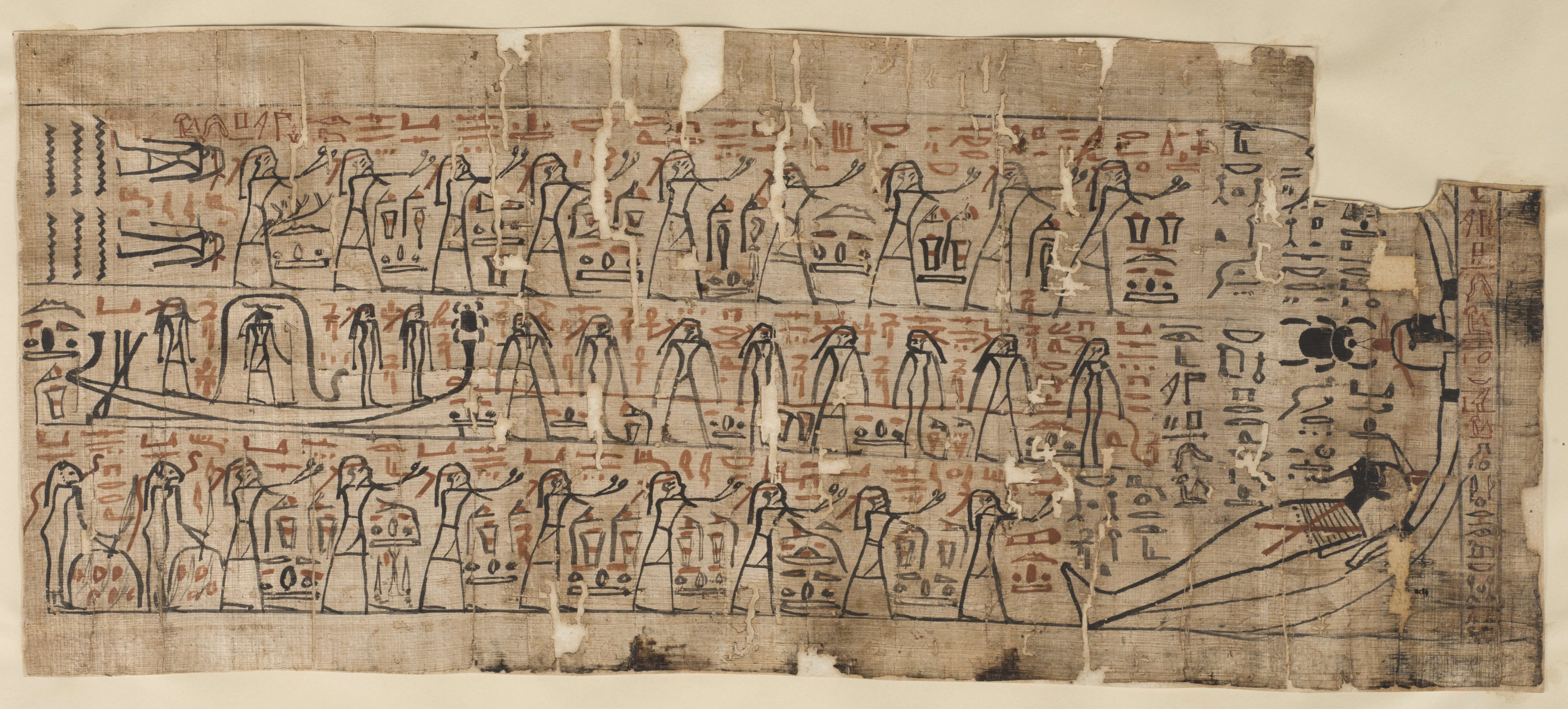
Il papiro Cat. 1785 presenta scene tratte dalla Decima, Undicesima e Dodicesima ora dell’Amduat, mentre la cosiddetta etichetta riporta una formula di offerta fra Ra-Harakhti, Ptah-Sokar-Osiride e il proprietario del manoscritto.
Questa composizione rappresenta perfettamente le tendenze funerarie di XXI dinastia e il desiderio del defunto di rinascere nell’unione osiriaco-solare.
La struttura narrativa del trattato consiste di tre registri orizzontali che descrivono da sinistra a destra la dimensione oltremondana della Dodicesima ora della notte; sulla sinistra del manoscritto, lo scriba riporta anche gli episodi più significativi della Decima e dell’Undicesima ora. Questi episodi sono rappresentati nelle prime scene del registro superiore e inferiore, rispettivamente Gli annegati (Decima ora) e La punizione dei dannati (Undicesima ora). La loro funzione consiste nel collegare le ultime fasi del periplo notturno dell’ipostasi solare con l’interno percorso notturno del Sole tramite l’applicazione del principio della pars pro toto.
La Dodicesima ora della notte descrive le ultime fasi del periplo notturno dell’ipostasi solare nell’Aldilà. Il registro centrale, infatti, riporta il processo di ringiovanimento del Sole attraverso le spire del (qui mancante) serpente anx-nTr.w (Vita degli dèi). Sulla destra del manoscritto si nota uno scarabeo, Khepri, il quale rappresenta l’aspetto rigenerato del disco solare all’alba che si appresta a emergere dall’Oltretomba tramite il passaggio creato dalle braccia del dio Shu. Nel registro superiore e inferiore, molte divinità assistono e partecipano alle ultime fasi del periplo notturno del Sole lodando il Grande dio. Quest’ora della notte presenta le seguenti scene: I dodici adoratori, La barca solare, I dodici dèi del traino, Le tredici dee del traino, Khepri e Shu, I dieci adoratori e La mummia di Osiride.
L’etichetta, sulla destra del manoscritto, riporta una formula di offerta con il nome del defunto, Piner. È interessante notare come questo nome costituisce un palinsesto che, in ognuna delle tre formule di offerta riportate, copre l’identità del precedente proprietario del papiro.
Third Intermediate Period (1076-664 BC)
Dynasty 21 (1076-944 BC)
Siamun/Psusennes II
Thebes
Acquisizione: Drovetti, Bernardino
Data acquisizione: 1824


Dodicesima ora
Reg. 1
Formula di offerta (l. 1)
Offerta che il re dona {a} Ra Harakhti e Ptah Sokar, signore della Cappella di Sokar,
Essi concedano ogni {cosa} che esce [sulla] loro tavola di offerta.
Essi (la) concedano {all’}Osiride, amato del dio, Piner, onorato.
Reg. 1-3
Formula di offerta (col. 1-9)
Offerta [che il re dona] a Ra-Harakhti, Ptah-Sokar-Osiride, signore dell’eternità e sovrano del tempo,
egli conceda un’offerta di provvigioni e ogni cosa buona e pura che esce sulla tavola d’offerta
all’Osiride, amato dal dio, Piner, onorato presso Osiride, signore dell’eternità e sovrano dell’Occidente.
Etichetta (col. 1)
[Osiride,] amato del dio, Piner, giustificato, figlio di Nebuben, onorato presso Osiride, signore dell’eternità, colui che presiede all’Occidente.
Enrico Pozzi (EP)
Shenali Boange (SB)
cursive hieroglyphs
Amduat, Formula Htp-di-nsw.t
Eleventh Hour, Tenth Hour, Twelfth Hour
STy.t-Chapel (STy.t)
Third Intermediate Period (1076-664 BC)
Dynasty 21 (1076-944 BC)
Siamun/Psusennes II
Yes
The manuscript’s visual representation describes the Sun-god Re’s nocturnal journey through the last three hours of the night. The treatise’s visual model does not resemble the prototype established that decorates the 18th Dynasty royal burial chambers in the Valley of the Kings. The scribe arranges the scenes without following the treatise’s standard protocol and presents the episodes according to his discretion. He replaces the cosmographical text with horror-vacui (fear of empty spaces: the filling of the entire surface of a space with details) like offering formulas and invocations to Re-Horakhty and Ptah-Sokar-Osiris. Therefore, several deities are missing from these scenes (deities 745, 747-748 in the Tenth Hour, deities 804-805 and 810-816 in the Eleventh Hour and deities 843-845, 846, 851-853, 861-869, 874-882, 906 and 907 in the Twelfth Hour). The treatise’s structure consists of three horizontal registers presenting Re, in his nocturnal shape as a ram-headed deity, travelling on the solar boat through the last three netherworld regions. In the top register from left to the right, the first scene presents the Netherworld’s merciful feature in which (the here missing) Horus’ hypostasis uses magic spells to assist two drowned corpses. This scene shows how the divine intervention of Horus can intercede for those who do not have the required funeral ritual arrangements as they have died an unfortunate or violent death or their bodies are missing or have drowned (like Osiris). In the following scene, nine worshipers, characterised by the typical adoration gesture with raised hands, praise the Great God. In the middle register, from left to the right, in order to complete Re’s rejuvenation process, four gods and four goddesses tow the solar barque to the eastern horizon. On the register’s right-hand side, a beetle (Khepri), the Sun-god in his renewed form, exits the Netherworld by travelling through the outstretched arms of the air-god Shu to be reborn as the sun disk at dawn. In the bottom register, from left to the right, the first scene presents one of the Netherworld’s apotropaic features where (the here missing) Horus’ hypostasis orders the destruction and annihilation of the hostile forces that interfere with establishing the natural order (Cfr. the Maat principle). Two knife-wielding lion-headed goddesses, with fire-spitting snakes on their shoulders, slaughter Re’s enemies over their fire-pits. The following scene presents eight worshippers adoring and praising sSm-iwf (Image of the flesh), the corpse of Osiris, who is restricted into the Netherworld’s boundaries.
Hornung E., Das Amduat:
die Schrift des verborgenen Raumes, Teil I–III (ÄA 7 und 13), Wiesbaden: Harrassowitz 1963-1967 (OEB10071-12422).
Niwinski A., Studies on the Illustrated Theban Funerary Papyri of the 11th and 10th Centuries B.C. (OBO 86), Fribourg / Göttingen: Universitätsverlag / Vandenhoeck Ruprecht 1989 (OEB 32792).
Sadek, A-A F., Contribution à l’étude de l’Amdouat: Les variantes tardives du Livre de l’Amdouat dans les papyrus du Musée du Caire (OBO 65), Freiburg / Göttingen: Universitätsverlag / Vandenhoeck Ruprecht 1985 (OEB 29751).