
Anonimo papiro dell’Amduat
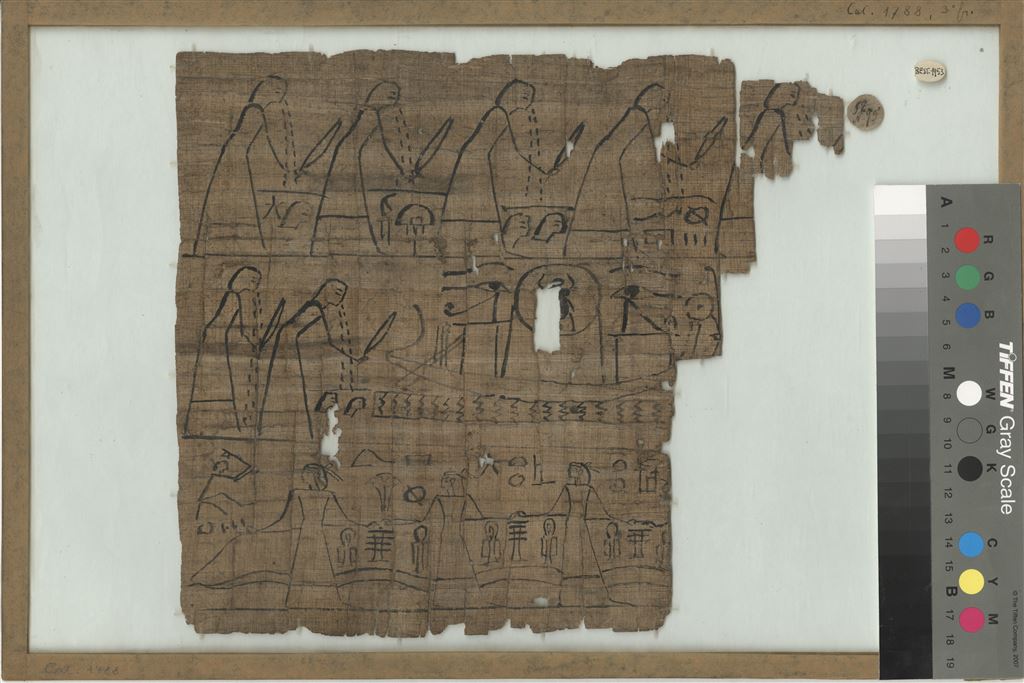
Il papiro Cat. 1788 presenta scene tratte dall’Undicesima e Dodicesima ora dell’Amduat.
La struttura concettuale del manoscritto consiste di tre registri orizzontali che accostano paratatticamente diversi episodi legati alla dimensione oltremondana, decontestualizzati e giustapposti una all’altro mediante processi analitici e simbolici.
Il registro superiore e centrale si distinguono per il carattere apotropaico, presentando la scena de La punizione dei dannati (Undicesima ora).
Il registro centrale presenta anche la scena de La barca solare (Dodicesima ora) che trasporta uno scarabeo, Khepri, raffigurato all’interno di un disco solare. L’aspetto rigenerato dell’ipostasi solare all’alba si trova fra due occhi udjat, un’iconografia ben nota che in questo caso trae probabilmente origine dalle vignette dei capitoli 102 o 136 del Libro dei Morti.
Infine, il registro inferiore presenta due scene tratte dal registro centrale della dodicesima ora della notte: I dodici dèi del traino e Il serpente del ringiovanimento.
Third Intermediate Period (1076-664 BC)
Dynasty 21/Dynasty 22 (986-840 BC)
---
Thebes
Acquisizione: Drovetti, Bernardino
Data acquisizione: 1824
Enrico Pozzi (EP)
Shenali Boange (SB)
cursive hieroglyphs
Book of the Dead, Funerary text, Amduat
Eleventh Hour, spell 102, spell 136, Twelfth Hour
Third Intermediate Period (1076-664 BC)
Dynasty 21/Dynasty 22 (986-840 BC)
---
Yes
The manuscript’s visual representation describes a specific segment of the Sun-god Re’s nocturnal journey through the Eleventh and Twelfth Hours of the night. The treatise’s visual model does not resemble the prototype established that decorates the 18th Dynasty royal burial chambers in the Valley of the Kings. The scribe arranges the scenes without following the treatise’s standard protocol and presents the episodes according to his discretion. Therefore, several deities are missing from these episodes (deities 804-805, 808, 810, 816 in the Eleventh Hour and deities 846-855 and 860-869 in the Twelfth Hour). The treatise’s structure consists of three horizontal registers presenting Re, in his newborn form as a beetle, travelling on the solar boat through the last netherworld regions. The top and middle register present one of the Netherworld’s apotropaic features where Horus’ hypostasis (here missing) orders the destruction and annihilation of the hostile forces that interfere with establishing the natural order (Cfr. the Maat principle): in fact, we see seven fire-spitting and knife-wielding goddesses slaughtering Re’s enemies over their fire-pits. In the middle register, the scribe presents the theme of travel. Here depicting the solar barque transporting a beetle, Khepri, the Sun-god Re’s renewed form, inside the solar disk of the Ax.t sign between two wedjat-eyes. In the bottom register, in order to complete Re’s rejuvenation process, three deities tow the solar barque through the entire body of the serpent anx-nTr.w (Life of the gods). This scene is reinforced through the tit and Dd signs; symbols of the deities’ endurance and vital strength.
Hornung E., Das Amduat:
die Schrift des verborgenen Raumes, Teil I–III (ÄA 7 und 13), Wiesbaden: Harrassowitz 1963-1967 (OEB10071-12422).
Hornung E., Texte Zum Amduat, Teil I-III: Kurzfassung und Langfassung, 1. bis 12. Stunde, Autographiert von Lotty Spycher und Barbara Lüscher (AH 13–15), Genève: Éditions de Belles-Lettres 1987–1994 (OEB 28504, 35567, 36111).
Niwinski A., Studies on the Illustrated Theban Funerary Papyri of the 11th and 10th Centuries B.C. (OBO 86), Fribourg / Göttingen: Universitätsverlag / Vandenhoeck Ruprecht 1989 (OEB 32792).
Quirke S., Going out in Daylight. prt m hrw. The Ancient Egyptian Book of the Dead: translation, sources, meanings (GHP Egyptology 20), London: Golden House Publications 2013 (OEB197753).
Sadek, A-A F., Contribution à l’étude de l’Amdouat: Les variantes tardives du Livre de l’Amdouat dans les papyrus du Musée du Caire (OBO 65), Freiburg / Göttingen: Universitätsverlag / Vandenhoeck Ruprecht 1985 (OEB 29751).