
Papiro dell’Amduat di Renenunet (?)
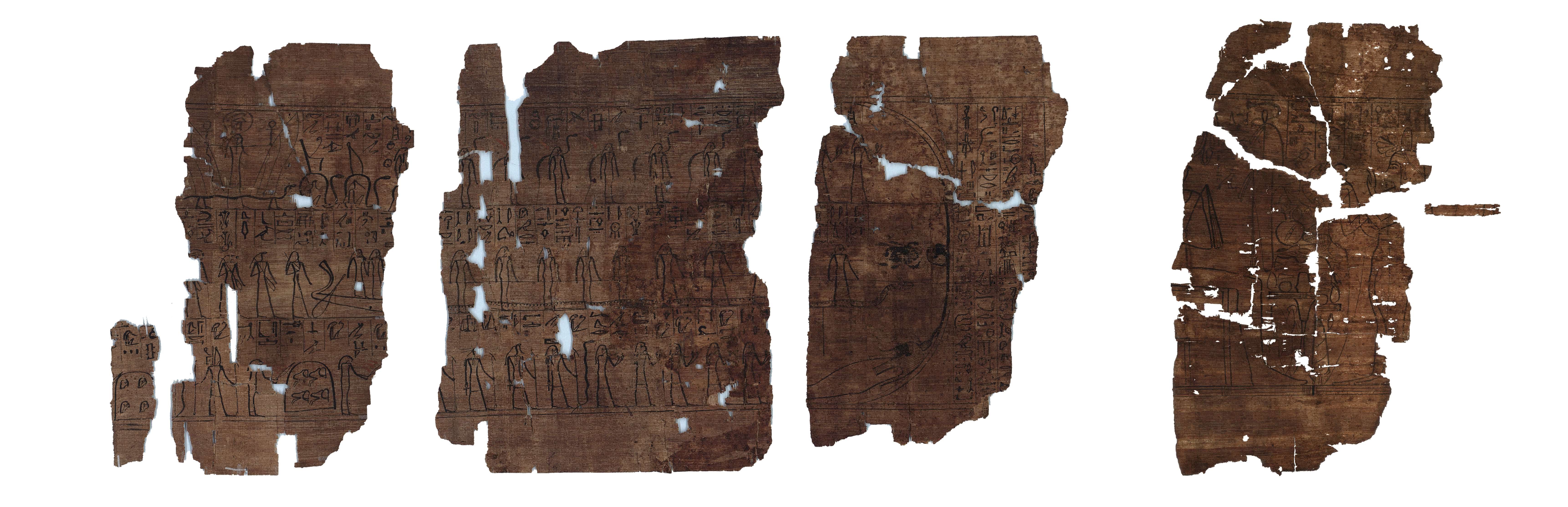
Il papiro Provv. 6260 presenta scene tratte dall’Undicesima e Dodicesima ora dell’Amduat, mentre la cosiddetta etichetta, sulla destra del manoscritto, riporta una formula e una scena di offerta fra Ra Harakhti, Ptah-Sokar e la defunta.
La struttura narrativa del trattato consiste di tre registri orizzontali che descrivono da sinistra a destra la dimensione oltremondana tramite una composizione di segni linguistici e visuali. Essi esprimono mediante processi di azione e reazione il rapporto fra il transito della barca solare e gli abitanti della Duat.
Sulla sinistra del manoscritto, l’Undicesima ora si contraddistingue per il carattere apotropaico, soprattutto per le scene di abbattimento e distruzione dei nemici di Ra nel registro inferiore, e presenta le seguenti scene: Atum e il serpente alato, Iside e Nefti come urei, Le dee sui serpenti, La divinità bicefala e La punizione dei dannati.
Nella parte centrale del manoscritto, la Dodicesima ora descrive le ultime fasi del periplo notturno dell’ipostasi solare nell’Aldilà. Il registro centrale, infatti, riporta il processo di ringiovanimento del Sole attraverso le spire del serpente anx-nTr.w (Vita degli dèi). Sulla destra del manoscritto si nota uno scarabeo, Khepri, il quale rappresenta l’aspetto rigenerato del disco solare all’alba che si appresta a emergere dall’Oltretomba tramite il passaggio creato dalle braccia del dio Shu. Nel registro superiore e inferiore, molte divinità assistono e partecipano alle ultime fasi del periplo notturno del Sole lodando il Grande dio e proteggendolo dalla minaccia della sua nemesi, il serpente Apopi. Quest’ora della notte presenta le seguenti scene: Le dodici dee con i serpenti, I dodici adoratori, La schiera dei rematori, La barca solare, Le tredici dee del traino, Il serpente del ringiovanimento, I dodici dèi del traino, Khepri e Shu, Le divinità primordiali, I dieci adoratori e La mummia di Osiride.
L’etichetta, sulla destra del manoscritto, riporta una formula di offerta fra Ra Harakhti, Ptah-Sokar e la defunta, Renenunet (?), mentre si conserva solo qualche frammento della scena di offerta che raffigura la defunta mentre compie una libagione e presenta delle offerte di fronte a Ra-Harakhti assiso in trono.
Third Intermediate Period (1076-664 BC)
Dynasty 21 (1076-944 BC)
Siamun/Psusennes II
Thebes (?)
Acquisizione: Drovetti, Bernardino
Data acquisizione: 1824
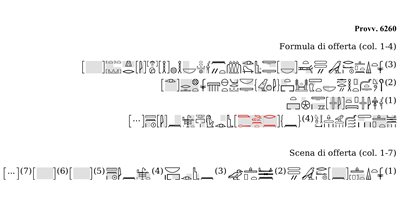

Formula di offerta (col. 1-4)
Offerta che il re dona a Ra-Harakhti, Atum, [signore] delle Due Terre, Osiride, colui che presiede agli Occidentali, signore dell’eternità, [che presiede] alla [I]geret […]
sovrano dell’eternità, e Ptah-Sokar, signore della Cappella Shetyt, {?}, signore della Terra Sacra, dell’Enneade cittadina […]
a occidente e a oriente, in cielo, [nella] terra e (nella) Duat.
Essi concedano offerte di provvigioni di pane e birra {a} [Renenunet, giustificata], Osiride, signora della casa, cantrice di [A]mon-Ra […]
Offerta che il re dona [a] Ra-Harakhti: essi concedano offerte di provvigioni a Osiride, signora della casa, cantrice di Amon-Ra […]
Enrico Pozzi (EP)
Shenali Boange (SB)
cursive hieroglyphs
Formula Htp-di-nsw.t, Amduat
Eleventh Hour, Twelfth Hour
Sacred land (tA-Dsr), Netherworld (dwA.t), STy.t-Chapel (STy.t)
Third Intermediate Period (1076-664 BC)
Dynasty 21 (1076-944 BC)
Siamun/Psusennes II
Yes
The manuscript’s visual representation describes the Sun-god Re’s nocturnal journey through the Eleventh and Twelfth Hours of the night. The treatise’s visual model does not perfectly resemble the prototype established that decorates the 18th Dynasty royal burial chambers in the Valley of the Kings. Therefore, some deities are missing (deities 772-774, 804, 810-813, 815-816 in the Eleventh Hour and deities 822-827, 835-843, 846-853, 856-864, 866, 870-877, 894-897 and 903-907 in the Twelfth Hour). The treatise’s structure consists of three horizontal registers representing the solar barque travelling through the last two netherworld regions. On the manuscript’s left-hand side, corresponding to the Eleventh Hour, the top register’s first scenes show Atum emerging from a winged serpent, followed by two crowned serpents resembling Isis and Nephthys. The third episode, which is not well preserved, presents one goddess riding a snake and bringing Re’s bidding in the sky to fruition. The bottom register presents one of the Netherworld’s apotropaic features. Instead of Horus’ hypostasis, there is the two-headed deity apr.w-Hr-nb-D.t (He with equipped face, Lord of time) who orders the destruction and annihilation of the hostile forces that interfere with establishing the natural order (Cfr. the Maat principle). Here, the serpent st-HH.w (He who burns millions) and the double lion-headed fire-spitting goddess slaughter Re’s enemies over their fire-pits. In the manuscript’s centre, corresponding to the Twelfth Hour, the top register presents six goddesses with fire-spitting snakes on their shoulders, punishing Re’s nemesis Apophis and brightening the Netherworld’s darkness, while three worshippers, characterised by the typical adoration gesture with raised hands, praise the Great God. In the middle register, to complete Re’s rejuvenation process, five goddesses and four gods tow the solar barque through the entire body of the life-regenerating serpent anx-nTr.w (Life of the gods). On the register’s left-hand side, we see four rowers at the stern of the solar barque, while on the register’s far right-hand side we see the accomplishment of the rejuvenation process: a beetle, the Sun-god’s renewed form, going out of the Netherworld by travelling through the outstretched arms of the air-god Shu to be reborn as the sun disk at dawn. The bottom register presents two couples of primaeval deities with wAs sceptres alongside the serpent nsr-m-ir.t=f (He who burns with his eye). In the final scenes, five worshippers adore and praise sSm-iwf (Image of the Flesh), the corpse of Osiris who is restricted into the boundaries of the Netherworld. On the manuscript's right-hand side, the offering scene is fairly damaged but shows the deceased offering funerary supplies and making a libation in front of Re-Horakhty.
Hornung E., Das Amduat: die Schrift des verborgenen Raumes, Teil I–III (ÄA 7 und 13), Wiesbaden: Harrassowitz 1963-1967 (OEB10071-12422).
Naguib S.-A., Le clergé féminin d’Amon thébain à la 21e Dynastie (OLA 38), Leuven: Peeters 1990 (OEB 33024).
Niwinski A., Studies on the Illustrated Theban Funerary Papyri of the 11th and 10th Centuries B.C. (OBO 86), Fribourg / Göttingen: Universitätsverlag / Vandenhoeck Ruprecht 1989 (OEB 32792).
Onstine S., The Role of the Chantress (Smay.t) in Ancient Egypt (BAR International Series 1401), Oxford: Archeopress 2005 (OEB 154482).
Sadek, A-A F., Contribution à l’étude de l’Amdouat: Les variantes tardives du Livre de l’Amdouat dans les papyrus du Musée du Caire (OBO 65), Freiburg / Göttingen: Universitätsverlag / Vandenhoeck Ruprecht 1985 (OEB 29751).